styles-md | Design Styles as Markdown for AI Agents
Overview
styles-md is an open library of design styles written as Markdown. Each style is one DESIGN.md file: the hard tokens live in the frontmatter, and the rules that need judgment live in the body. You can hand the file to a coding agent, or compile it straight to CSS.
Telling an agent "clean, modern, generous spacing" gets you generic output, and there is no way to test a vibe. So every style is split into two layers:
| Layer | Where | What it holds | Who applies it |
|---|---|---|---|
| Deterministic | Frontmatter | Colours, type ratio, spacing unit, radii, motion, fonts | A compiler, no model involved |
| Judgment | Markdown body | Principles, component specs, an explicit Do / Don't list | A model |
What a style compiles to
One DESIGN.md builds into every format a project might want:
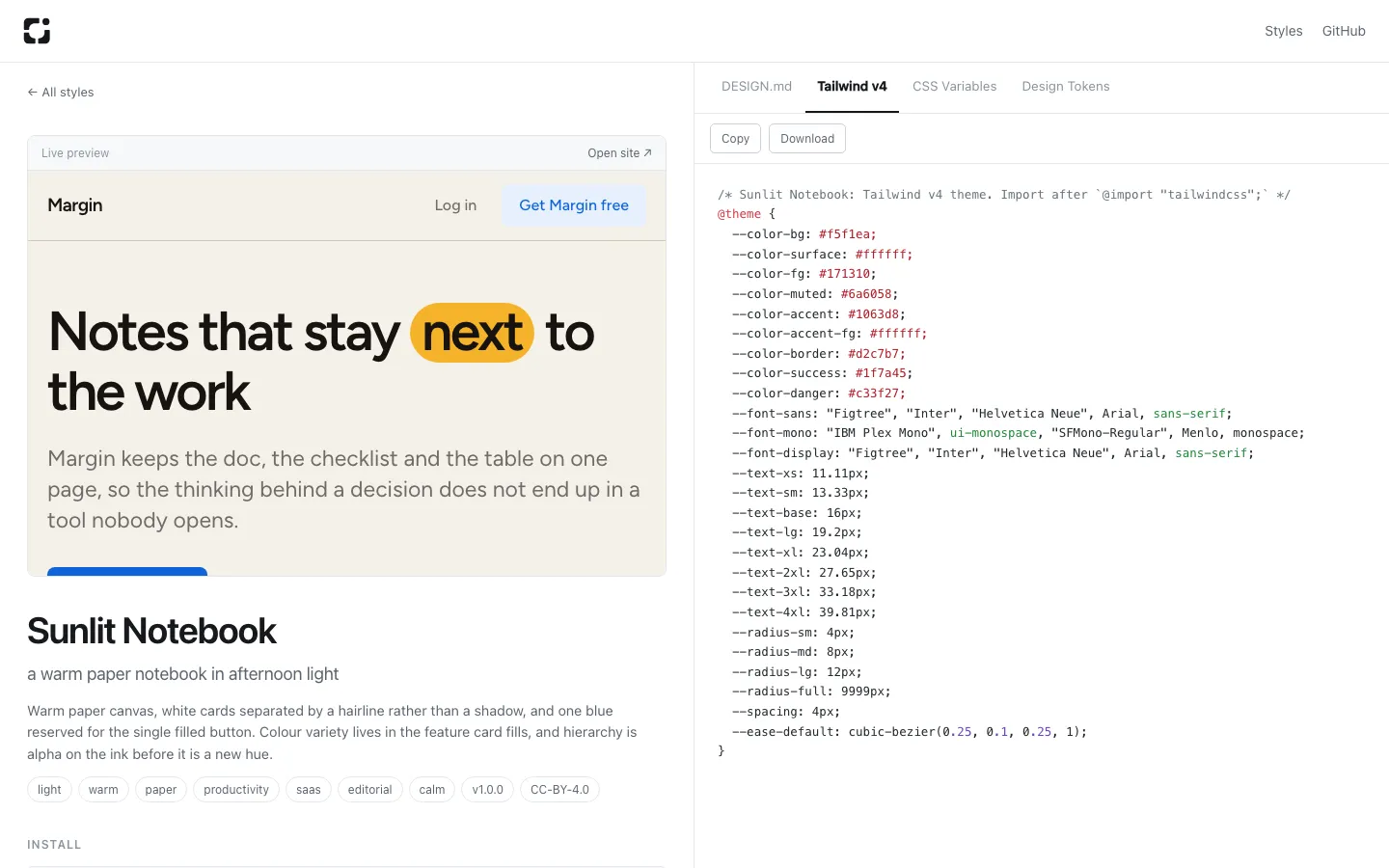
style.csswith CSS custom propertiestheme.css, a Tailwind v4@themeblockshadcn.csswith shadcn/ui variables in oklchtokens.jsonfor toolingDESIGN.min.md, a compact spec kept under about 900 tokens so it leaves room in the agent's context for your own code
A small CLI writes the theme and both specs into a project, reading static files from the published site. There is no account, no API key and no backend: git is the database and the site is the registry.
Quality gates
A style does not merge unless CI passes all of these:
- Schema: the frontmatter validates against one Zod schema, shared by the CLI, CI and the Astro site
- Contrast: every required colour pair clears WCAG AA, including muted text and accent labels
- Sections: Principles, Components and Do / Don't are all present
- Token budget: the compact spec stays under its limit
- Fonts: every family is declared with a licence that is free for commercial use, and no font file is ever committed
- Artefacts: generated files must match a fresh build, so nothing is edited by hand
The gallery
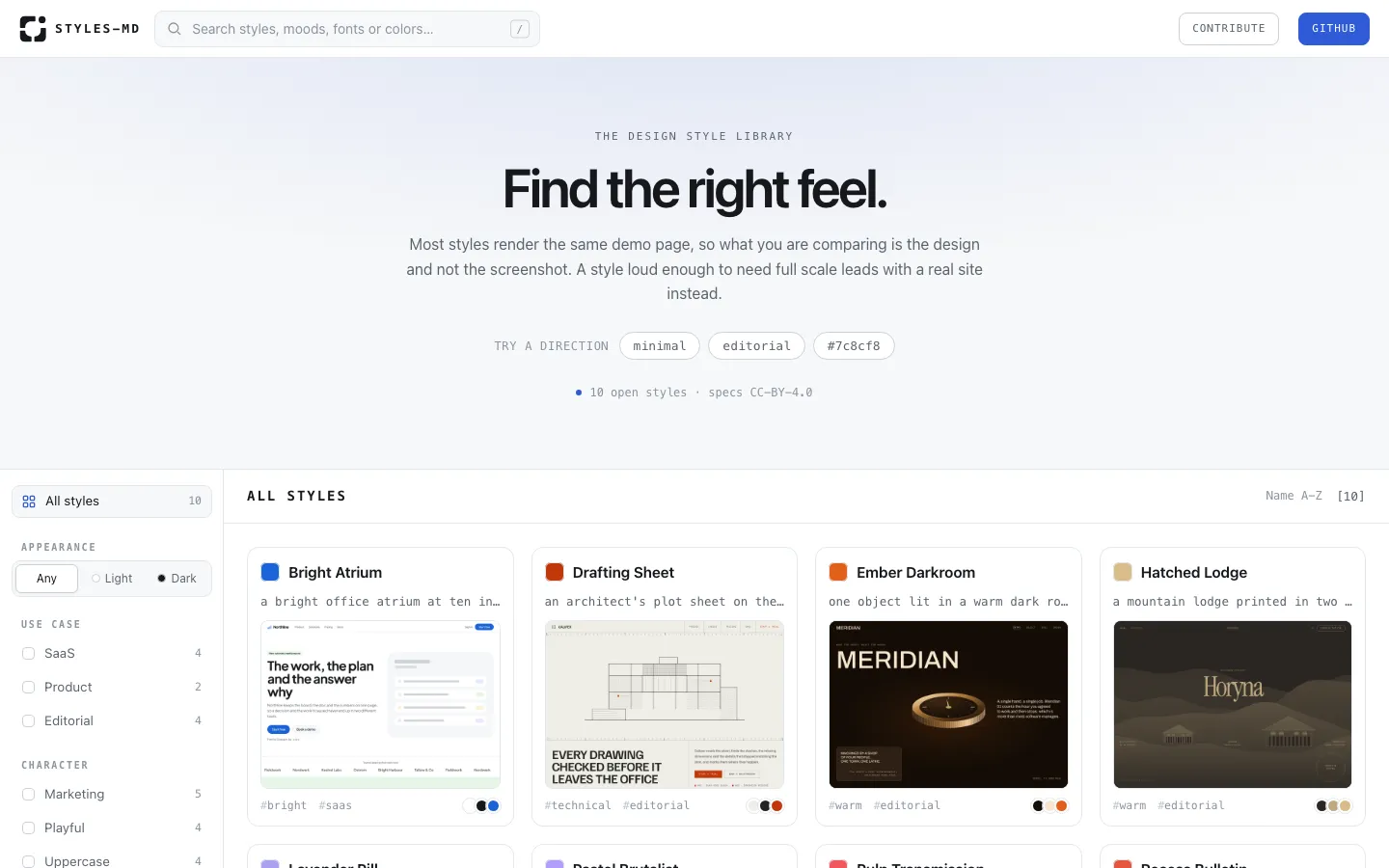
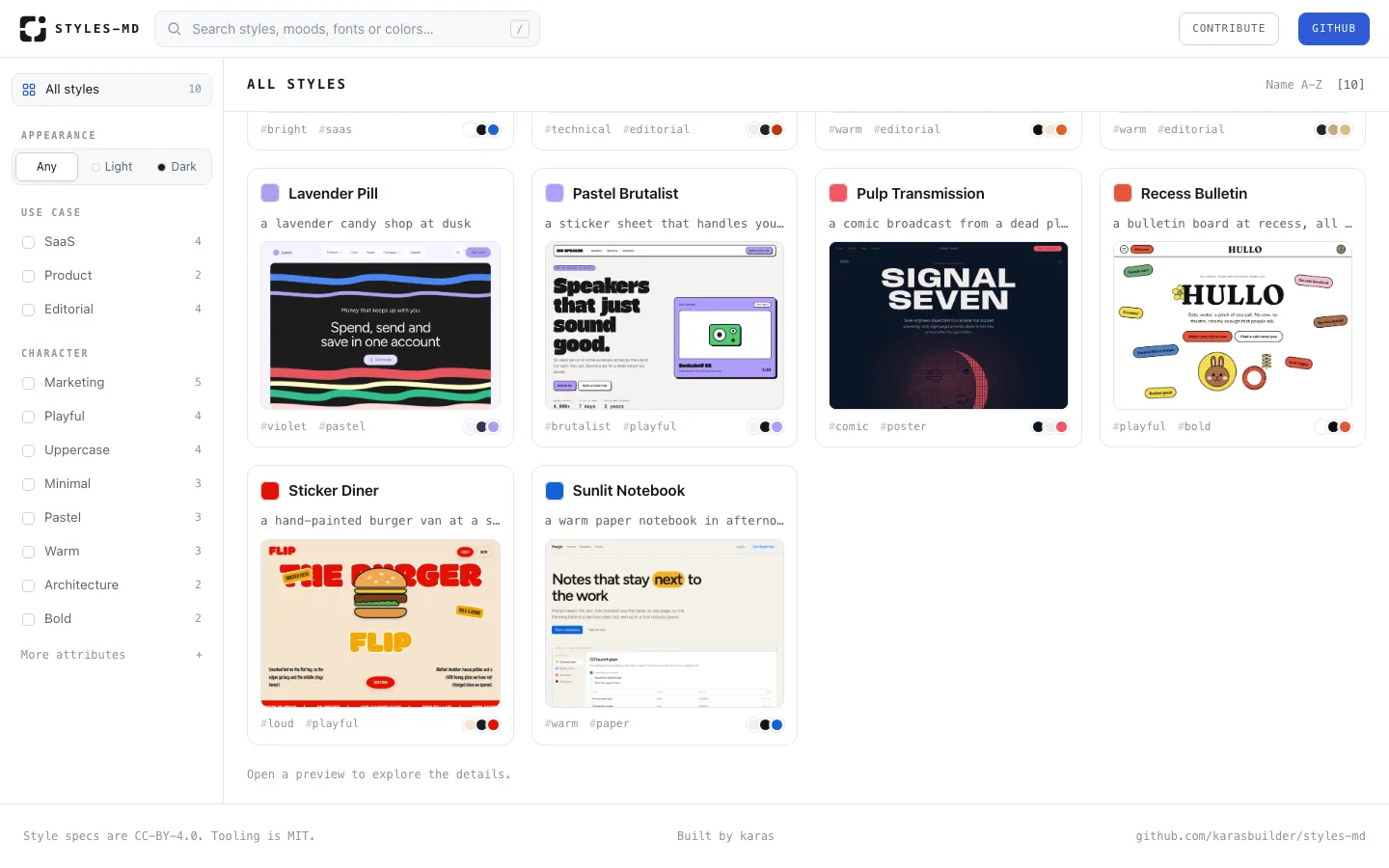
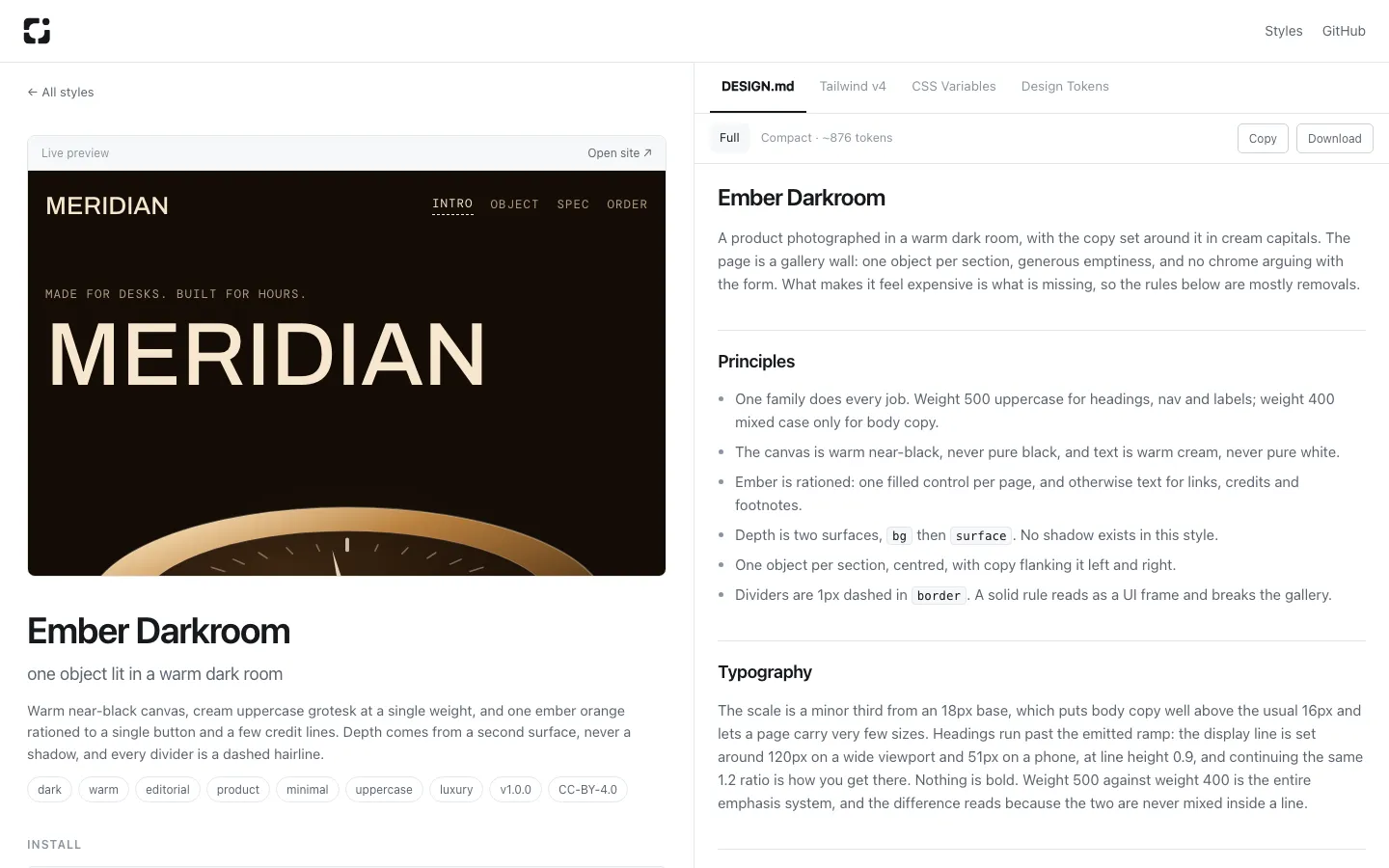
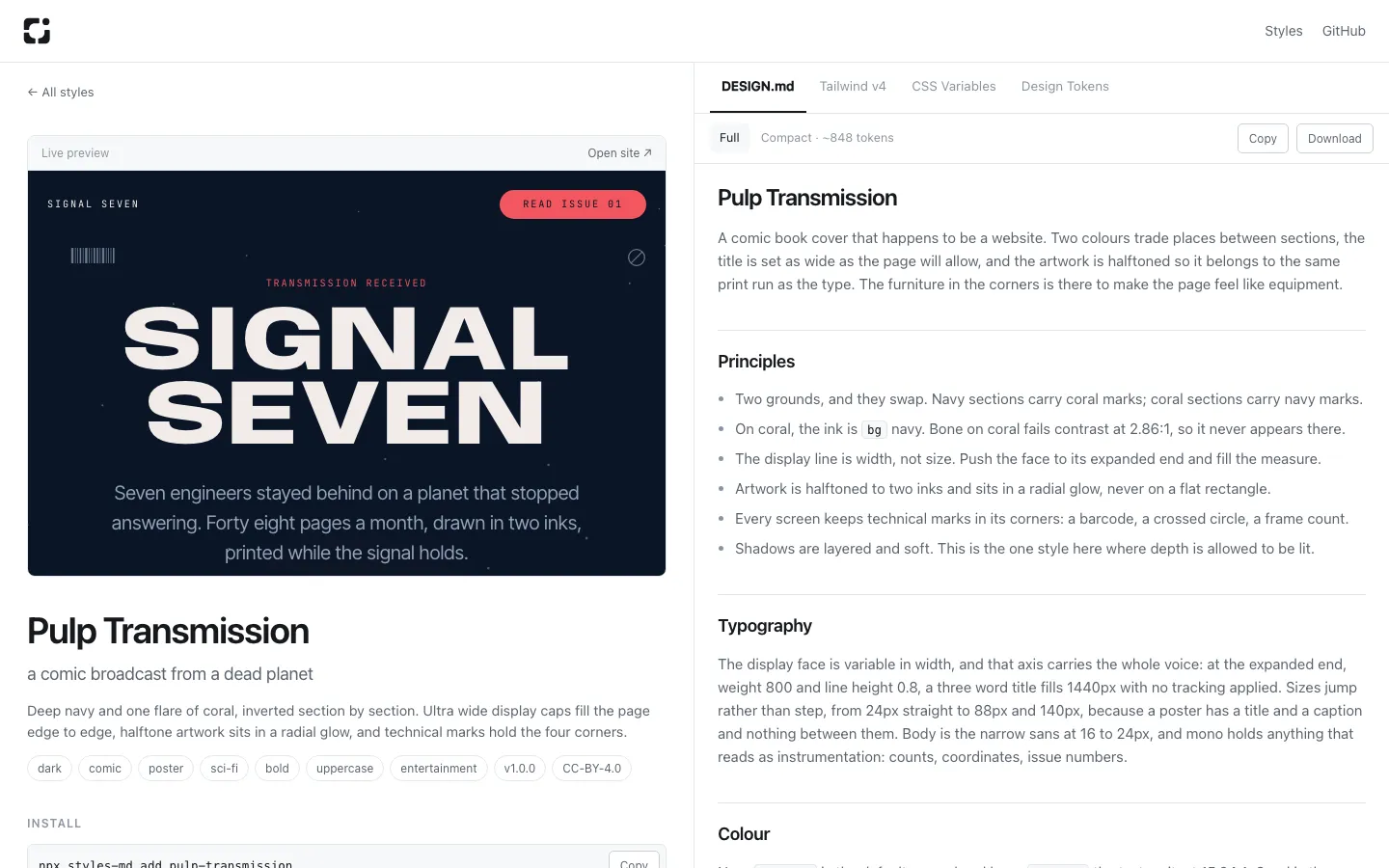
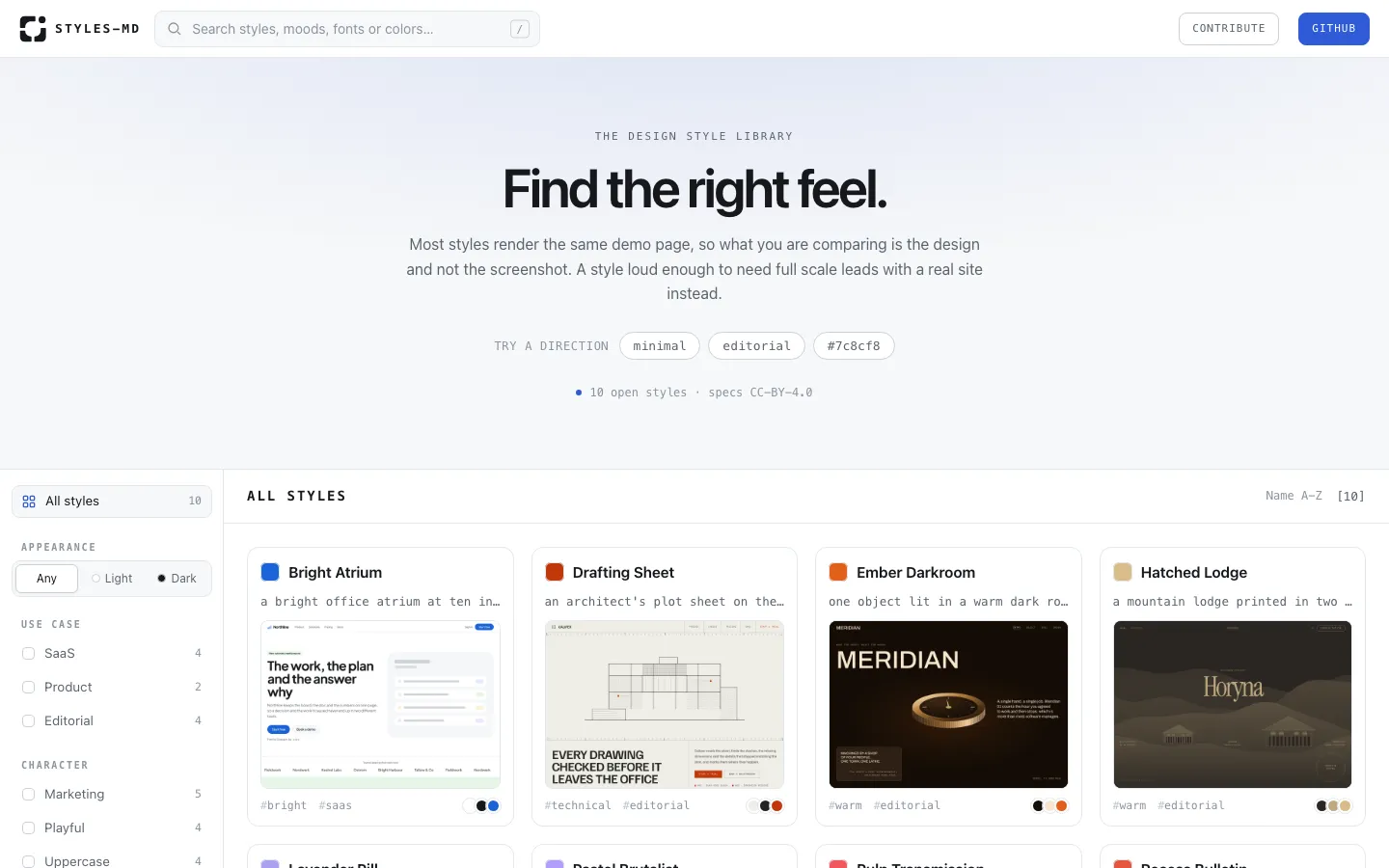
The Astro site at style.karasdev.com shows 10 original styles, from Bright Atrium and Sunlit Notebook to Ember Darkroom and Pulp Transmission. Most styles render the same demo page, which only reads --sm-* variables, so what you compare is the design and not the screenshot. Styles too loud for that canvas lead with a real site instead.
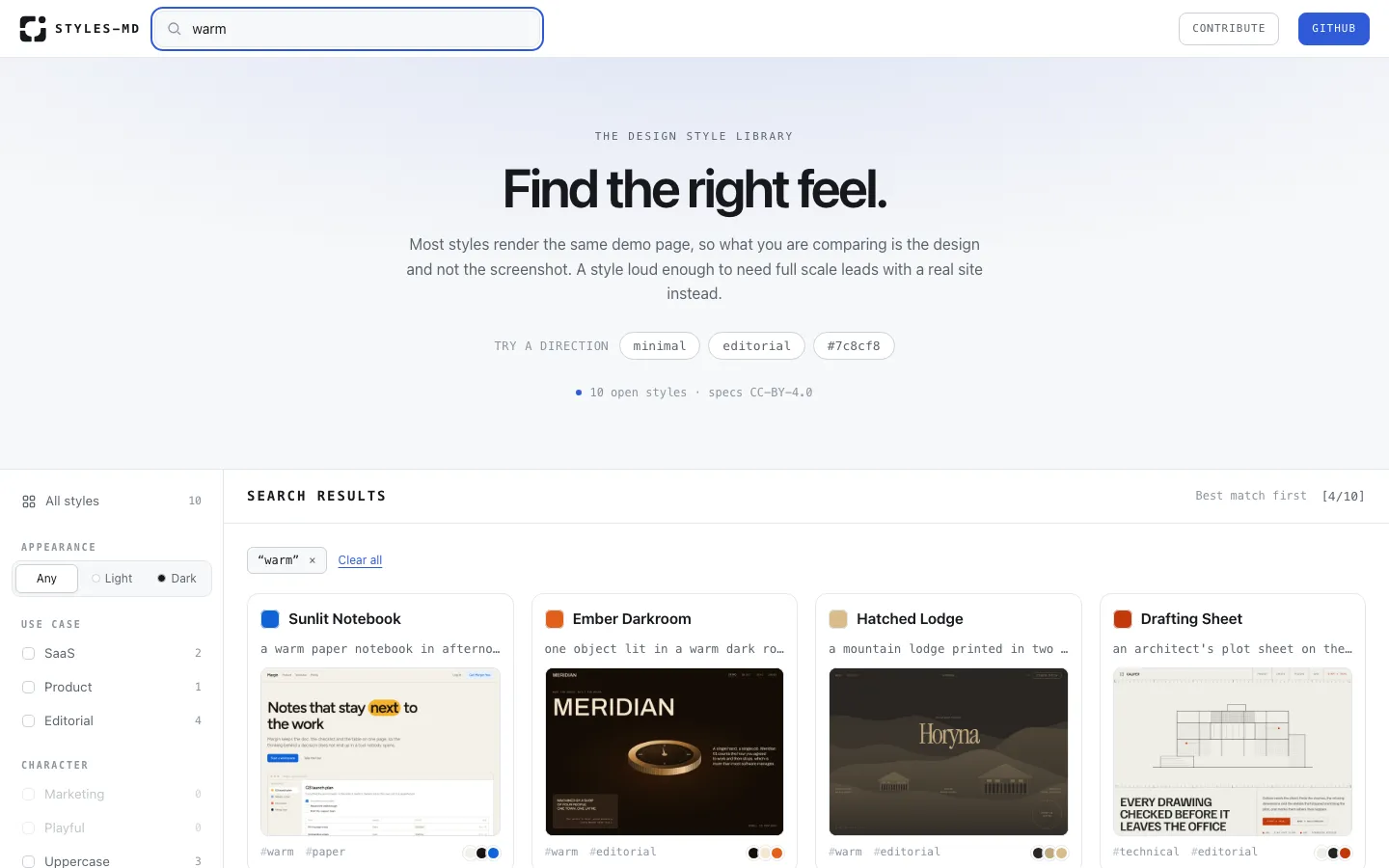
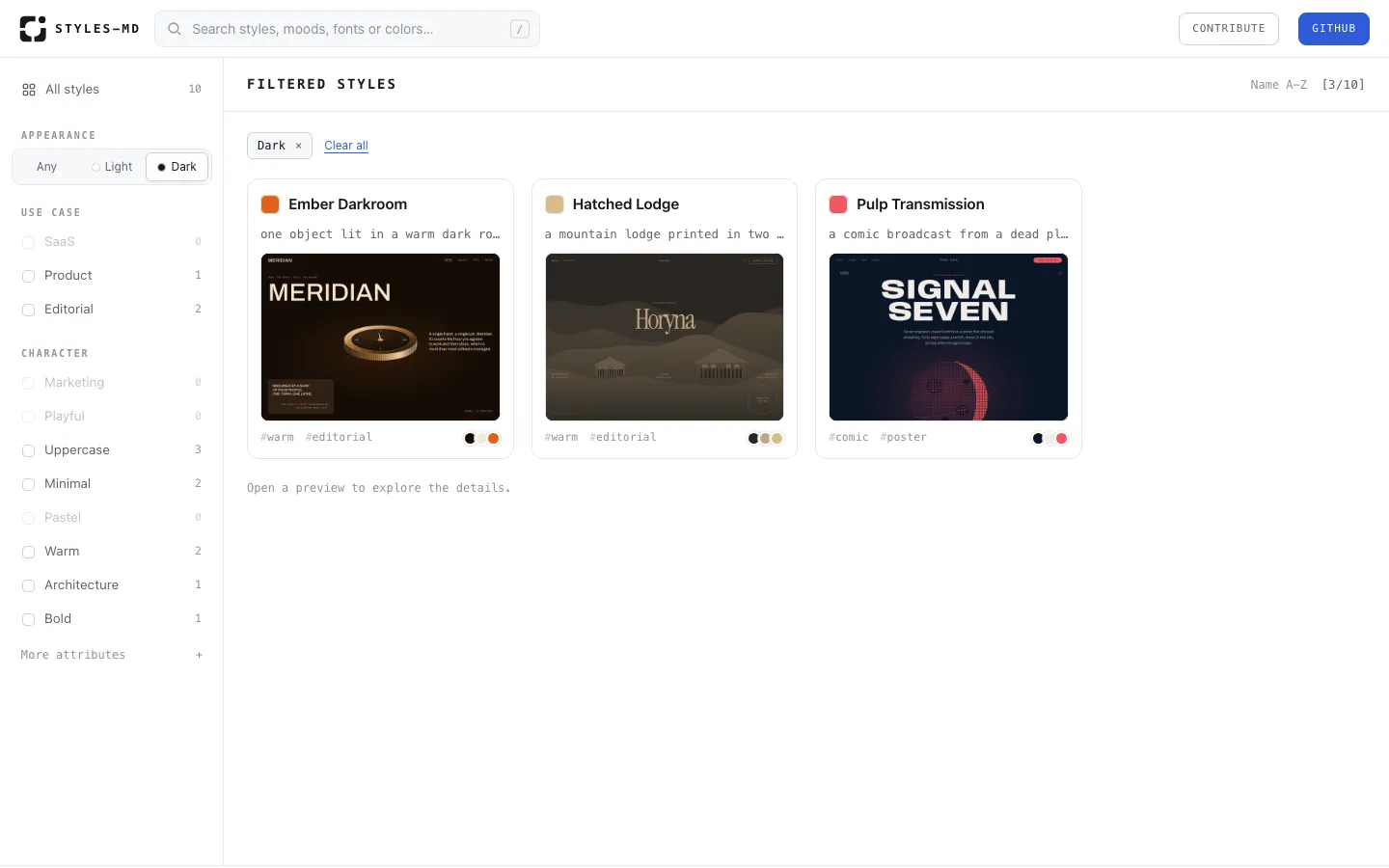
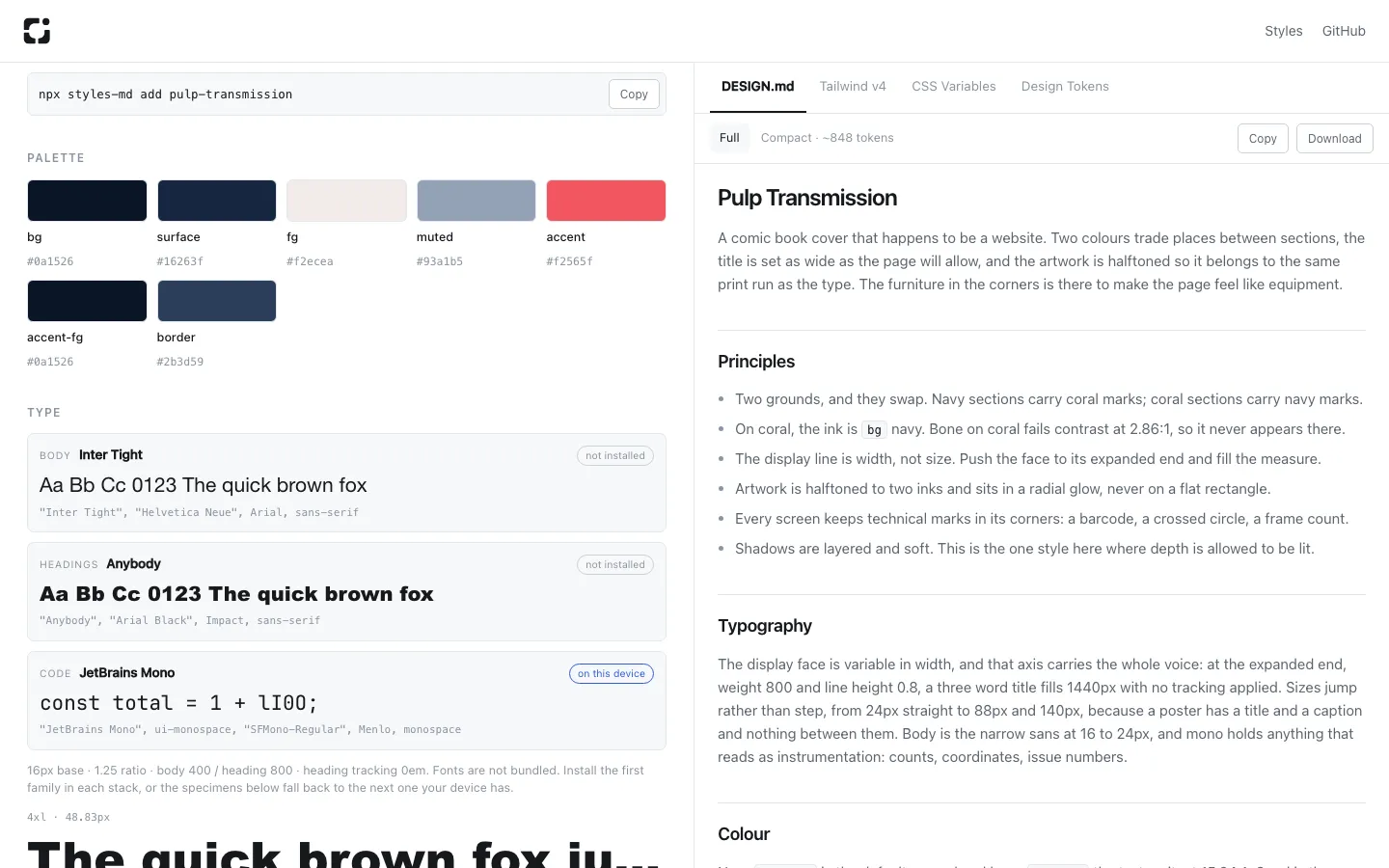
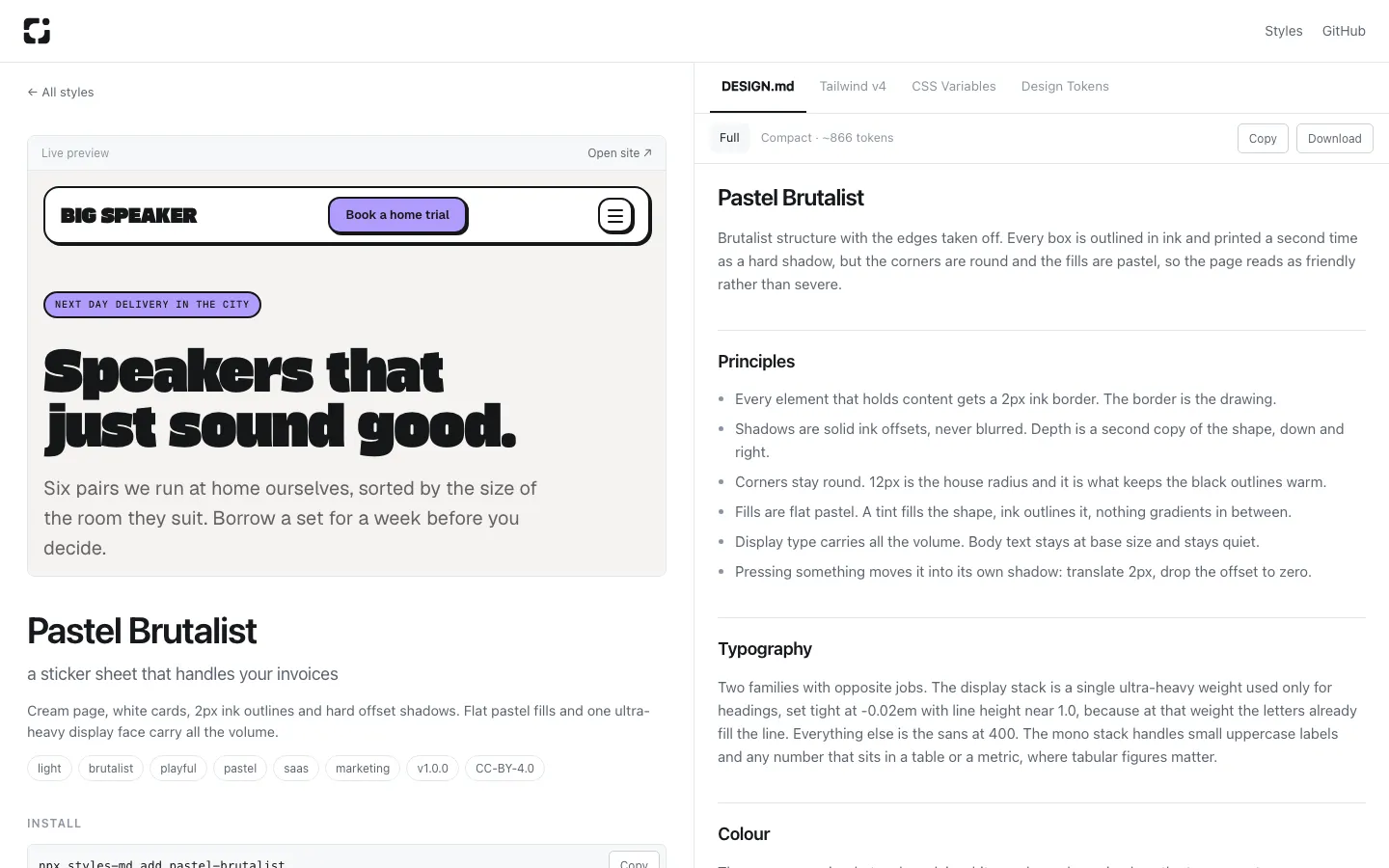
Each style page has a live preview, the palette and type specimens, and tabs to copy or download the spec as DESIGN.md, Tailwind v4, CSS variables or design tokens. The gallery has faceted filters (appearance, use case, character) and search across names, moods, fonts and colours.
Real sites, not just demos
Every style is backed by a real site built from its spec (Meridian, Horyna, Signal Seven, Big Speaker, Margin, Flip and more), each deployed on its own. Link checks confirm every showcase URL resolves, and that a site marked as embeddable really can be framed.
Styles are moods, not brands
Every style is an original system named after a feeling, such as pastel-brutalist or ember-darkroom. The project never publishes clones of real companies' design systems, which avoids trademark and trade dress problems. Specs are CC-BY-4.0 and the tooling is MIT.
Project Gallery